Nagarjuna Language Institute
For The Study Of Classical Tibetan


Home
Driving Directions
About Tibetan Classes
Links
Ithaca
Contact Us
Past Programs


Eighth Annual Summer Classical Tibetan Language Intensive

Photo of the public school in Rongbatsa, Kham by Lauren Cottrell

Six Weeks of Classical Tibetan
In Ithaca, New York

Session One: June 9-27, 2008 
Session Two: July 7-25, 2008
$1,500 for both sessions, or 
$750 for one session 

Two Levels Of Classical Tibetan Are Offered In Each Session:
Beginning Classical Tibetan, and
Intermediate Classical Tibetan

Classes Taught By Craig Preston, Author of How To Read Classical Tibetan, Volume I: Summary of the General Path, and How To Read Classical Tibetan, Volume II: Buddhist Tenets (forthcoming from Snow Lion).

Introductory Classical Tibetan

This class is for students who have never studied Classical Tibetan, or who wish a review from the beginning. We will start with learning how to write the alphabet. We will learn how syllables are pronounced and learn how to read simple sentences. This class is a good way to get a large amount of instruction in a few weeks. You will be surprised how much progress you can make, especially if you have been studying on your own.

Intermediate Classical Tibetan

The intermediate class is for students who know the pronunciation rules, can recognize words, and have some experience with sentences. In this course we will look at how Tibetan sentences are constructed. 

I usually teach a beginning class and an intermediate class, one in the morning and one in the afternoon. Classes go about two hours, maybe a bit more. Its rather intensive. 

The summer session is primarily a Tibetan Language intensive. I may teach some topic in the evening for non-language students. There will be special events because stuff always happens.

Ithaca , NY , is in rural upstate New York , in the Finger Lakes . The town has about 25,000 residents. It is a college town, home to Cornell University and Ithaca College . Because it is a college town, it is easy for students to find summer sublets cheaply, within walking distance.

Ven. Tenzin Lama is a frequent guest.

Book News

How To Read Classical Tibetan, Volume II:
Buddhist Tenets

Jay-dzun-ba's Presentation of Tenets
Translated and Annotated for language Students 
By Craig Preston

320 pages, with first occurrence glossary of new particles, words, and phrases complete glossary, index of sentence diagrams.

This book is an annotated translation of Jay-dzün Chö-gyi-gyel-tsen’s Presentation of Tenets, a short manual on the tenets of the four schools of Indian Buddhism, composed in Tibet at the beginning of the seventeenth century. I have written this book for Tibetan Language students who are interested in learning to read works on Buddhist tenets in Tibetan. Accordingly, this book focuses on the concerns of language students—learning the basic vocabulary of tenets and understanding the structure of the sentences themselves.

What Reviewers Are Saying About Introduction To Buddhist Tenets

William Magee, author of Fluent Tibetan, The Nature of Things, and 
She Still Lives: A Novel of Tibet —

Teachers and students of Classical Tibetan were empowered last year when Craig Preston introduced Volume I of his "How to Read" series. For the first time, students had access to an actual Tibetan text (Dzong-ka-ba's "Brief General Path") in a bilingual format, complete with grammatical analysis, translation into English, and commentary on essential philosophical points. This year, Preston again favors intermediate Tibetan students, this time with How To Read Classical Tibetan, Volume II: Buddhist Tenets  -- Jay-dzün Chö-gyi-gyel-tsen's "Presentation of Tenets." Volume II is, surprisingly, even better than Volume I, with complete grammar presented in the Joe Wilson "Translating Buddhism from Tibetan" mode, lists of vocabulary, elegant translation, and cogent discussions of difficult points of doctrine. In this volume, Preston makes it clear that even if his forte is the clarification of Tibetan grammar, his training and inclination is towards philosophical exegesis. No one interested in the subtleties of Ge-luk philosophical thought can afford not to purchase this great addition to Snow Lion Publications' growing list of Preston's invaluable works.

Snow Lion has also published two books of interest to NLI readers.

BUDDHIST PHILOSOPHY
Losang Gönchok's Short Commentary to Jamyang Shayba's Root Text on Tenets

by Daniel Cozort and Craig Preston
352 pp., 6" x 9" trade paper
$18.95

Click Here to Order From Snow Lion

What are the most important points of difference between the major schools of Buddhist philosophy? This rich, medium-length survey offers a lively answer. The introduction, aimed at those new to Buddhist thought, sets up a dialogue between the schools on the most controversial topics in Buddhist philosophy.

Jamyang Shayba was the greatest Tibetan writer on Philosophical tenets. Losang Gönchok's Clear Crystal Mirror, a concise commentary on Jamyang Shayba's root text, represents a distillation of many centuries of Indian and Tibetan scholarship. Buddhist Philosophy skims the cream of Jamyang Shayba's intellect, providing a rare opportunity to sharpen our intellect and expand our view of Buddhist thought.

Daniel Cozort is associate professor and chair of the Department of Religion at Dickinson College where he teaches the religions of India. He is the author of Highest Yoga Tantra.

Craig Preston studied at the University of Virginia and has taught Classical Tibetan at Namgyal Institute. He is author of How to Read Classical Tibetan, Vol. 1: Summary of the General Path and currently teaches Tibetan and Buddhist philosophy privately in Ithaca, New York.

Also available now from Snow Lion:

HOW TO READ CLASSICAL TIBETAN: 
Volume 1, Summary of the General Path

by Craig Preston

247 pp., 11" x 8 1/2" trade paper
$39.95

Click here to order from Snow Lion.

Do you want to learn to read Classical Tibetan? If you know how to read the Tibetan u-chen script and can recognize words, How to Read Classical Tibetan will show you--at your own pace--all the relationships that make Tibetan easy to read. It is a complete language course built around the exposition of a famous fifteenth century Tibetan text summarizing stages of the path to Buddhahood.

All the language tools you need to work at your own pace are in one place. You won't need a dictionary because all of the words and particles are translated and explained upon every occurrence, and there is a complete glossary at the end of the book; every sentence is diagramed and completely explained so that you can easily see how the words and particles are arranged to convey meaning.

Because everything is always explained in every sentence, you will easily learn to recognize the recurrent patterns, making the transition from learning words to reading sentences much easier for you. As you study How to Read Classical Tibetan, you will learn to: recognize the syntactic relationships you encounter, understand the meaning signified, and translate that meaning correctly into English.

"Using this book, I improved my own comprehension and knowledge of Classical Tibetan. I am delighted to recommend it to all students who wish to deepen their understanding of this sacred language. Learning to read Classical Tibetan will give you direct access to the words of the great masters."--Ven. Segyu Choepel Rinpoche

Some Class Photos

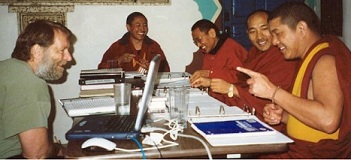
Winter 2002 in Taos, New Mexico
Left to right, Craig Preston, Ven. Tenzin Lama, Ven. Geshe Choenyi, Ven. Geshe Shayrap, and Ven. Geshe Gelek, all from Sera Jay Monastic College.


This page has been visited Hit Counter times since March 24, 2002.